Teaching
CePI-POCUS understands that training in point-of-care ultrasound (PoCUS) is an essential part of developing the clinical competencies of 21st-century nurses.
We believe that incorporating PoCUS into the training process is a transformative strategy for strengthening clinical reasoning, diagnostic accuracy, and evidence-based decision-making—essential competencies for professionals who wish to work autonomously, with quality and safety, in different care settings.
Undergraduate Education
The CePI-POCUS has been actively working towards the inclusion of point-of-care ultrasound in nursing curricula, in accordance with the National Curriculum Guidelines, which reinforce the importance of critical thinking, clinical reasoning, and evidence-based practice as pillars of nursing education.
Our actions seek to raise awareness and support Brazilian public universities in incorporating PoCUS as an essential formative component, aligned with the following axes:
- Care in health care,
- Research and innovation in health, and
- Professional and technological development.
We understand PoCUS as an extension of the physical examination, an instrument that expands the professional’s ability to interpret semiological findings, improve clinical reasoning and diagnosis, and strengthen professional autonomy in direct patient care.
In this way, CePI-POCUS reaffirms its commitment to critical, reflective, and interprofessional training, preparing future professionals to face the challenges of this and the coming centuries, in accordance with the principles of the Brazilian Unified Health System (SUS), comprehensive care, and responsible technological innovation.
Postgraduate Studies (Stricto Sensu)
In 2023, CePI-POCUS consolidated a historical milestone by offering the first course on Point-of-Care Ultrasound (PoCUS) in stricto sensu Postgraduate Nursing Programs in Brazil and throughout Latin America.
This pioneering initiative was conceived with the purpose of training highly qualified researchers, capable of conducting rigorous scientific studies and generating evidence that impacts clinical practice and health policy.
In 2025, the course takes a new step and begins to be offered in a network, involving programs of excellence from EERP-USP, UNIFESP, UFPR, UFSC, and UNICAMP.
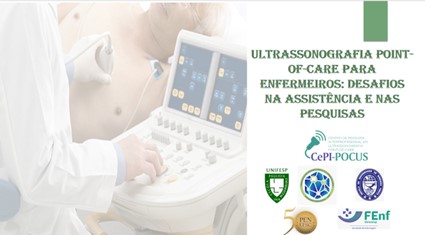
This interinstitutional configuration strengthens national scientific collaboration, enhances the production of interdisciplinary knowledge, and stimulates the development of new care and teaching technologies.
Our goal is to innovate, break paradigms, and redefine boundaries.
More than “thinking outside the box,” we seek to deconstruct the box, adopting a disruptive, creative stance committed to scientific advancement and the consolidation of Brazil as an international reference in PoCUS (Proof of Conception, Urgency, and Innovation).