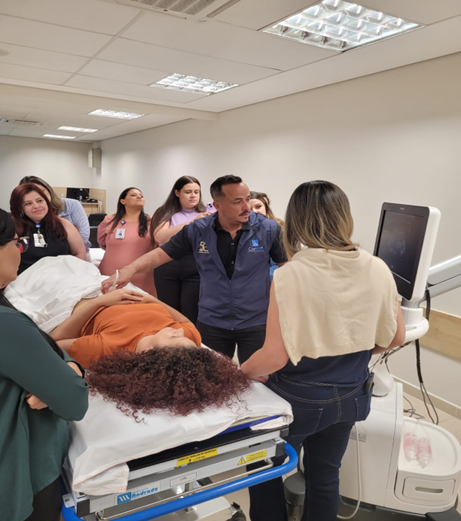
Renal colic, often caused by ureteral stones, causes severe flank pain. Although computed tomography is the gold standard, point-of-care ultrasound (POCUS) offers a faster, safer, and radiation-free alternative for initial evaluation.
Introduction
Renal colic is commonly characterized by sharp, severe flank pain. It is often caused by ureteral stones that obstruct urinary flow. The diagnostic gold standard is non-contrast CT. It offers high accuracy but is expensive, has risks of ionizing radiation exposure, and has resource implications. In recent years, point-of-care ultrasound (POCUS) has emerged as an effective, non-invasive tool in the evaluation of suspected renal colic.
Why Use POCUS for Renal Colic?
POCUS offers several advantages:
- Rapid Assessment
- Immediate availability at the point of care, providing timely care and diagnosis
- No ionizing radiation
- Low Cost
- Easy-to-Perform Reproducible Follow-Up Scans
- Better Patient Care
- Potentially Reduces Emergency Room Stay Time
- Transducer Selection
The ideal transducer for this application is a low-frequency curvilinear transducer.
You can also use a low-frequency phased array transducer if a curvilinear transducer is not available. A modern multifrequency transducer with a wide frequency range can also be used if a frequency in the 3.0 to 5.0 MHz range is available.
Preset
Use the renal or abdominal preset. For the longitudinal view, scan with the transducer orientation marker pointing cephalad. For a transverse view, scan with the transducer orientation marker pointing to the patient’s right side. Using the renal preset may enable specific calculation packages for assessing the urinary system. For example, calculating bladder volume using an ultrasound device.
Patient Position
The ideal patient position is supine. Additional views can be obtained in the left and right lateral decubitus positions. Sometimes, we may even consider the prone position for posterior scanning if the aforementioned positions do not provide an optimal view of the kidneys.
Normal Ultrasound Results

Figure 1. Longitudinal view of the right kidney. Note the normal echogenic pelvic-allergic system. There is no evidence of hydronephrosis or calculi.
Left Kidney
Visualization of the left kidney can sometimes be more difficult due to obstruction of vision by intestinal gas at the splenic flexure of the colon. Perform the scan with the patient in the supine or right lateral position. Position the transducer in the lower right intercostal region, in the left posterior axillary line, with the ultrasound beam directed at the left kidney.
Ureters
The ureters are usually not visible if there is no obstruction to the flow of urine from the renal pelvis to the bladder. In some cases, bladder outlet obstruction due to advanced BPH can cause backpressure and distend the ureters. A common scenario would be obstruction to the flow of urine due to a ureteral stone. Ureteral stones can be difficult to diagnose for the new user. Lower ureteral stones obstructed at the ureterovesical junction may be easier to visualize with ultrasound. Simply follow the ureter downward from the pelvis-ureteral junction when the ureter is distended.
Bladder


Diagnostic Results with POCUS
Hydronephrosis
The primary role of POCUS in renal colic is the detection of hydronephrosis (dilation of the renal pelvis and calyces due to urinary obstruction).
Ultrasound sensitivity – ranges from 72 to 76% for hydronephrosis when performed by emergency physicians.
Ultrasound specificity – ranges from 55 to 60%, improving for larger stones (> 5 mm).
Moderate or severe hydronephrosis strongly suggests obstruction secondary to urolithiasis. Be aware that ureteral compression can also be caused by a mass or enlarged lymph node, or even bladder outlet obstruction (these patients would not have renal colic).
Direct Stone Visualization
Although ultrasound is less sensitive than CT, it can still aid in imaging and diagnosing stones in most patients. The main findings are:
- Hyperechoic (bright), round, oval, or irregular lesion (stones) in the renal collecting system or ureter
- Stones with posterior acoustic shadowing
- Scintillating artifact on color Doppler, very useful for detecting small stones
Let’s look at some examples below.


Evaluating Complications
POCUS can also be used to detect complications such as pyelonephritis and perinephritic fluid/urinoma, suggesting fornix rupture. See the images below.


Role of CT Scan
In high-risk individuals who continue to have fever or individuals with a functioning kidney, a history of transplant, or suspected infection, CT scanning may be indicated to make a definitive diagnosis.
Clinical Workflow
- Initial Assessment – History, examination, urinalysis.
- POCUS – Identify hydronephrosis and, if possible, stones.
- Management – If mild/absent hydronephrosis, normal ureteral jet observed on the affected side, good pain control, low-risk features – manage in an outpatient setting.
If moderate/severe hydronephrosis or lack of improvement, consider referral to CT and/or urology. Educate the patient about the risk of kidney injury if left untreated.
CT Scan
If an ultrasound examination is inconclusive due to intestinal gas or the patient’s body habitus, CT scanning should be considered if there is concern for moderate or severe hydronephrosis.
Evidence and Guidelines
Guidelines recommend considering ultrasound as the initial imaging test in typical low-risk presentations.
Some commonly encountered scenarios in patients with renal colic
- Kidney stone with acoustic shadowing – A bright (hyperechoic) lesion in the lower calyx, with a dark posterior shadow, is characteristic of a kidney stone. See Figure 14.
- Hydronephrosis – Dilated renal pelvis and calyces indicating obstruction—classified as mild, moderate, or severe.


Doppler Scintillation Artifact
Color Doppler imaging, which shows the “scintillation artifact” after a stone, can aid in the detection and confirmation of kidney stones, especially small stones.

Figure 14. The image on the left shows a cross-sectional B-mode image of the bladder with a large echogenic stone within the bladder lumen. A dense acoustic shadow is visible posterior to the stone. The image on the right shows a scintillating artifact posterior to the stone in color Doppler. This confirms that it is a stone. In this case, it is very clear that a large stone is visible on the B-mode image. The scintillating artifact is useful in confirming small kidney stones. Images courtesy of renalfellow.org
Conclusion
POCUS is an excellent tool for evaluating patients with suspected renal colic. It allows for rapid assessment of the urinary system for evidence of kidney stones and/or hydronephrosis. It can help reduce unnecessary CT scans and improve patient care and resource utilization.
CT scans may still be necessary in individuals with a high BMI or those who cannot visualize the urinary system via ultrasound for technical reasons. We can reduce unnecessary patient exposure to ionizing radiation by adopting an approach that prioritizes ultrasound, combined with an appropriate and relevant history, physical examination, and POCUS findings, to improve patient safety and quality of care.
Source: https://www.ultrasoundcases.info/